I Learned This in a Theatre Class, Not a CFRE Program
Nobody taught me how to make an ask in my CFRE prep course.
They taught me the principle of it. The language around it. The theory. But the actual mechanics — the thing that makes a donor say yes instead of "let me think about it" — I learned that in a black-box theatre with bad lighting and a professor who had no patience for wasted moments.
I didn't expect that to be the most useful thing I carried into a development career.
What Theatre Taught Me That Fundraising Training Did Not
The professor stopped us mid-scene.
We were running a two-hander — kitchen table, a confrontation that was supposed to crack something open between two characters. We'd rehearsed it. We thought we knew it. He let us go for maybe ninety seconds before he held up one hand.
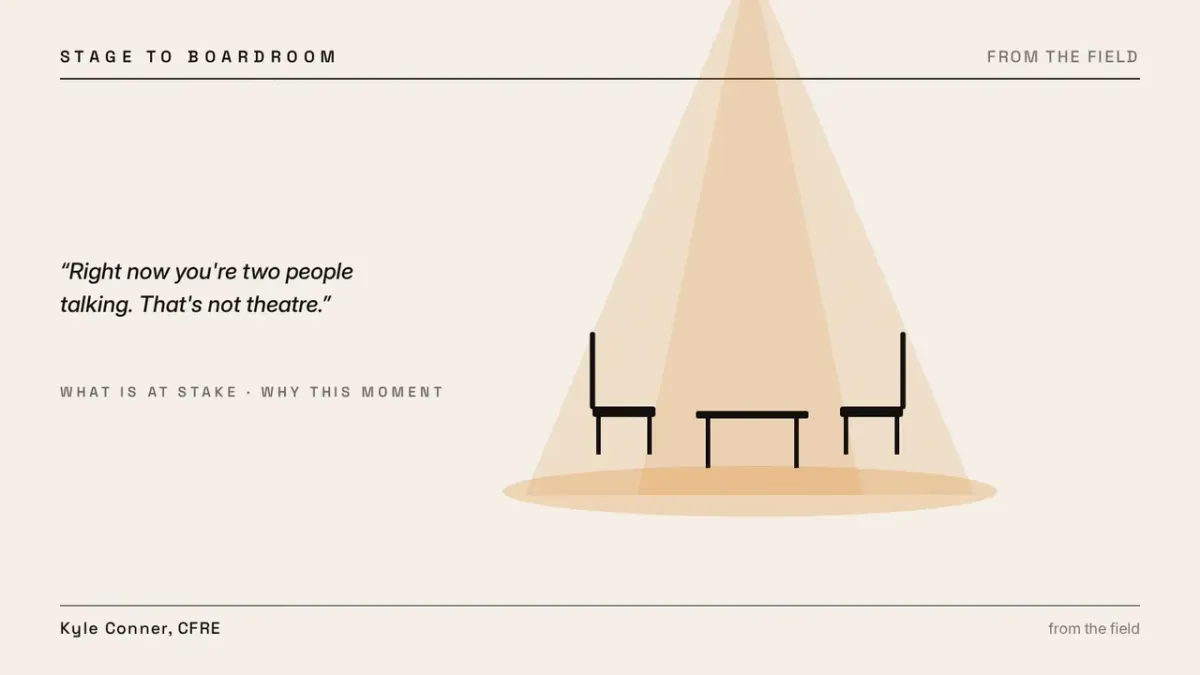
"What is at stake in this scene?"
Silence.
"What does your character stand to lose if this conversation goes wrong?"
I knew my lines. I could've started from the top without looking at the page. I had no answer for that question.
He didn't raise his voice. That would've been easier. He looked at us and said, "Come back when you know what's at risk. Right now you're two people talking. That's not theatre."
He ran every scene class the same way. Before you step into the scene, answer two questions: what is at stake, and why does it matter in this moment and not next week? If you can't answer both, you're not acting. You're performing. There's a difference, and he had no patience for the second one.
I didn't know it then, but he was describing every major gift conversation I'd ever go on to walk into underprepared. Two people talking. No stakes. No theatre.
I sat in that classroom thinking about playwriting. I wasn't thinking about donor meetings.
But I kept coming back to those two questions years later, sitting across from people who had the capacity to give and who cared about the work. The meeting would be going well. The relationship was warm. The case was solid. And then I'd get to the ask, and something would go flat. Not hostile. Just flat. They'd lean back slightly. Say something noncommittal. And I'd leave without a commitment.
It took me longer than I want to admit to see what was happening. I was showing up to those meetings without stakes and without timing. I had a number. I had a project. But I hadn't given them a reason the decision mattered today, or made clear what was actually at risk if they said no or said nothing.
That's not a fundraising problem. That's a theatre problem. I was giving them dialogue without a scene.

Stakes Are Not Urgency. Timing Is Not a Deadline.
A lot of fundraisers get this wrong. I did, for a while.
Stakes and urgency aren't the same thing. Urgency is a tactic — the matching gift that expires at midnight, the campaign thermometer that needs ten more donors by Friday. Those things work in direct mail. They don't work in a major gift conversation, because a sophisticated donor sees through manufactured pressure the same way an audience can tell when an actor is performing emotion they don't feel.
Stakes are real. They're what's actually true about the situation: the program that can't expand without this gift, the window that exists because of where the organization is right now. You don't manufacture stakes. You surface them.
Timing works the same way. It's not a deadline. It's a reason. There's a difference between telling someone "we need to close this by year end" and helping them understand why this moment in the organization's story is the right moment for their involvement. One is pressure. The other is an invitation into something real.
My theatre professor would've called the first one a plot device and the second one a scene.
I had a donor who'd given $1,000 a year for three years. She'd told me at a cultivation visit that she wanted to do more "when the time was right." I heard that as a signal and asked at our next meeting. She said she'd think about it.
She wasn't saying no. I knew she wasn't saying no. But I left without a commitment, and when I ran the meeting back, I couldn't tell you what had actually been at stake in that room. The relationship was warm. The case was solid. She cared about the kids. I'd shown up with a number and a project and nothing else.
I went back six months later. Different preparation. I came in knowing that we had a gap in mobility funding — kids outgrow their wheelchairs the same way they outgrow shoes, except a custom chair runs ten to twenty thousand dollars and Medicaid doesn't cover it. Many of our kids would use a chair for the rest of their lives. I knew why it mattered that year and not the next: there was a board match on the table through December, and her gift at that level would be the first to close it.
She gave $25,000.
The ask wasn't different. I wasn't smoother or more prepared in any obvious way. I just walked in knowing the answers to both questions before I sat down.
You can map any visit the same way: what happens to a specific person if we wait until next year? And what does this gift solve today that a gift next year can't?
Storytelling Is the Delivery System
Information doesn't move people. Story does.
That sounds like a cliché until you watch it fail in real time. I've sat through presentations where a program officer walks a donor through impact data and a theory of change, and the donor nods politely and writes a small check. And I've watched a program director spend four minutes telling one family's story, and the donor leans forward and asks, "What would it take to fund this for the next three years?"
The data was in the room both times. The difference was the delivery system.

Theatre trained me to ask: whose story is being told, and what is the audience meant to feel by the end? Those aren't soft questions. They're structural ones — and you can ask them about a donor conversation the same way you'd ask them about a scene.
The gifts that actually closed, the ones that felt earned on both sides, almost all of them had a story at the center. A specific person up against something real. And then an ask that connected the donor's capacity to that specific thing.
The CFRE gives you the framework: the ask, the proposal, the follow-up, the acknowledgment. It's a good framework. But the framework is scaffolding. The story is what makes the building stand.
What I Carry Into Every Room Now
I don't run a theatre company. I build revenue programs for nonprofits. But I answer both questions before every significant ask I make or coach someone else through.
What is at stake? Not organizationally — in the actual life of someone this organization serves. And why does this moment matter? Where is the organization, and what becomes possible if this donor steps in now?
If I can't answer those questions clearly before I walk in, I'm not ready. Not because the training says so. Because a professor in a black-box theatre told me a long time ago that a scene without stakes is just people talking.
He was right about plays. He was right about asks, too.